Buying guide · 4 min read

pH strips or a pH meter: which should you buy?

When cheap strips are genuinely enough, and when you need a number you can record.

Short answer

Buy strips if a rough reading is enough and you test occasionally, and a meter if you need a number you can record, repeat and compare. The real cost of a meter is not the device: it is the calibration buffers and the storage solution the probe needs to stay usable.

As an Amazon Associate I earn from qualifying purchases. Affiliate Disclosure

The options

pH test strips

pH Test Strips

Good

  • Cheap, and ready the moment you open the tube
  • No calibration, batteries or storage solution
  • Long shelf life if kept dry and closed
  • Nothing to break

Trade-offs

  • You read a colour, so the result is approximate
  • Hard to compare two readings precisely
  • Coloured or cloudy samples make the match harder

View on Amazon: pH Test Strips (opens in a new tab)What it is →

Digital pH meter

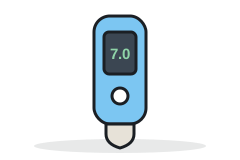
Digital pH Meter

Good

  • A number you can write down and compare
  • Repeatable when calibrated
  • Many models correct for temperature automatically

Trade-offs

  • Needs calibrating with buffer solutions
  • The probe must be stored moist, never dry
  • Probes wear out and eventually need replacing
  • Ongoing cost for buffers and storage solution

View on Amazon: Digital pH Meter (opens in a new tab)What it is →

Choose the range, not just the product

Wide-range strips cover the whole scale coarsely; narrow-range strips cover a few units finely. If your samples always sit in a narrow band, narrow-range strips can be more useful than a cheap meter, because you are comparing against closely spaced colours.

What a meter really costs

  • Calibration buffer sachets or solutions, used up over time
  • Storage solution, which the probe sits in between uses
  • A replacement probe eventually, on models that allow it
  • The minute or two of calibration before readings you rely on

Looking after a probe

The one mistake that ends a meter early is letting the probe dry out. It is stored in storage solution, not water and not dry in a drawer. Rinse between samples with distilled water rather than wiping the bulb, which scratches it.

Using strips well

  • Keep the container closed: damp air ruins the strips inside
  • Read the colour at the time the instructions state, not later
  • Compare in daylight rather than under coloured lighting
  • Do not dip a strip back into the sample twice

Common questions

Are strips accurate enough?

For a rough check, yes. For a value you will record and compare against another reading later, a calibrated meter is the right tool.

Do I need temperature compensation?

It matters when samples are not at room temperature, because pH readings shift with temperature. If everything you test is room temperature, it matters less.

Can I calibrate a meter with anything else?

No. Use the buffer solutions intended for it. Household liquids have no reliable, stated pH.

Supplies mentioned

Buying guides

As an Amazon Associate I earn from qualifying purchases. Product links on this site go to Amazon. Qualifying purchases may earn me a commission at no additional cost to you, and Amazon handles the order. Affiliate Disclosure